Abstract
In Borno State, Nigeria, and much of sub-Saharan Africa, particularly the Sudano-Sahel region, groundwater is crucial for the development of both urban and rural areas. More than half of the state's population depends directly on this resource for daily water needs. This study aims to develop a local, sustainable water management framework, based on the opinions of primary local stakeholders, to address water management challenges in Borno State, Northeastern Nigeria. To achieve this, a stakeholder analysis methodology was employed, and relevant stakeholders in Borno State were engaged through Focus Group Discussions and Interviews to provide the necessary solutions. The main challenges to sustainable water management in the state include limited technical and human resources, insufficient investment, and funding shortages. Additional issues include a lack of stakeholder participation in groundwater management and the fragmentation of national institutions responsible for water oversight. The results from the interviews and focus groups show that educating citizens to raise awareness about the benefits of safe, clean water and environmental protection is crucial. The current legislative framework is not producing sustainable results in water management. Some problems in achieving sustainable water management stem from the people's ethics, beliefs, and cultural norms regarding water issues in the state. Additionally, institutional stakeholders noted that the state's current top-down governance structure is a significant obstacle, often leading to inconsistencies in government policy implementation. University stakeholders emphasized the need for stronger connections between various national and regional institutions. Overall, the stakeholders suggested five key strategies to address the problem. The findings of this study will be vital for achieving sustainable water management in Borno State, and the lessons learned can be applied to other states. The recommendations can be implemented by water managers and may support the attainment of the Sustainable Development Goals in the state.
1. Introduction
Groundwater is critical for agricultural, industrial, and domestic water supplies in Africa. It is estimated that approximately 2.03 billion people worldwide rely on this critical water supply for survival. In 2021, the global per capita consumption of this precious resource increased to approximately 22.6%
| [14] | Loaiciga, H. A., & Doh, R. (2024). Groundwater for people and the environment: a globally threatened resource. Groundwater, 62(3), 332-340.
https://doi.org/10.1111/gwat.13376 |
[14]
. Furthermore, according to Global Water Outlook 2025, the world's water demand is rapidly increasing, threatening food production and global food security
| [25] | Pattern M. (2016) Questionnaire research: A practical guide. Routledge. |
[25]
.
Currently, more than 45 percent is used for other purposes, including global irrigation, 55 percent of drinking water, and a significant portion of global industrial activity
| [3] | Balasubramanya, S. (2025). Groundwater use in agriculture in South Asia: The role of technology. Agricultural Economics, 56(3), 474-484. https://doi.org/10.1111/agec.70004 |
| [13] | Karandish, F., Liu, S., & de Graaf, I. (2025). Global groundwater sustainability: A critical review of strategies and future pathways. Journal of Hydrology, 133060.
https://doi.org/10.1016/j.jhydrol.2025.133060 |
| [16] | McGrath TF, Elliott CT, Fodey TL. (2012) Biosensors for the analysis of microbiological and chemical contaminants in food. Analytical and bioanalytical chemistry. 2012 Apr; 403(1): 75-92. https://doi.org/10.1007/s00216-011-5685-9 |
| [23] | Niazi, H., Ferencz, S. B., Graham, N. T., Yoon, J., Wild, T. B., Hejazi, M., & Vernon, C. R. (2025). Long-term hydro-economic analysis tool for evaluating global groundwater cost and supply: Superwell v1. 1. Geoscientific Model Development, 18(5), 1737-1767.
https://doi.org/10.5194/gmd-18-1737-2025 |
[3, 13, 16, 23]
. Groundwater is critical for the growth of Nigerian cities, and rural areas have been investigated for the spatial and temporal variations in groundwater sustainability across various climatic regions of the country
| [11] | Hassan, Y., Saleh, A., & Tijjani, A. Y. (2025). Groundwater dynamics in the Komaduga-Yobe basin: modeling 20 years of historical trends to forecast future scenarios (2020–2040). Academia Environmental Sciences and Sustainability, 2(1).
http:/doi.org/10.20935AcadEnvSci7602 |
[11]
. We
used GRACE satellite data to study spatiotemporal variations in Terrestrial Water Storage (TWS) in Nigeria from 2002 to 2024 as applied by
| [1] | Adetokunbo, P., Eluyemi, A. A., Aguda, S., Jegede, E., Omoseyin, T., Sanuade, O. A., & Adesina, R. B. (2025). Decadal Trends and Periodicity of Terrestrial Water Storage in Nigeria-GRACE Satellite Observations. Open Journal of Geology, 15(7), 343-357. https://doi.org/10.4236/ojg.2025.157017 |
[1]
.
Currently, more than 80 million of Nigeria's 220 million people do not have access to clean water, and 140 million do not have access to basic sanitation. Furthermore, approximately 90-95% rely directly on this natural resource for their daily water requirements
| [2] | Bakari A (2014) Assessing the impact of anthropogenic activities on groundwater quality in Maiduguri, Nigeria. The International Journal of Engineering and Science: 3(4): 35-40. https://doi.org/10.5897/JGMR13.0196 |
[2]
. With a rapid population growth rate of about 2.5% per year, water demand has steadily increased over the last few decades, and this trend is expected to continue. The provision of safe drinking water has deteriorated in Borno State and throughout the country; for example, access in urban areas across Nigeria has decreased from 79% to 70% over the last 26 years
| [21] | Mohammed, AM (2017) Developing Methodologies for Sustainable Groundwater Management in the Chad Basin Around Maiduguri. An Unpublished PhD thesis. Abertay University of Dundee, Scotland, UK. |
[21]
. This unbearable downward trend is primarily caused by inadequate management frameworks, limited technical and human capabilities, and insufficient investment and funding. Other concerns include the exclusion of stakeholders from water resource management and the uneven nature of Nigeria's water management institutions
| [21] | Mohammed, AM (2017) Developing Methodologies for Sustainable Groundwater Management in the Chad Basin Around Maiduguri. An Unpublished PhD thesis. Abertay University of Dundee, Scotland, UK. |
| [30] | United Nations. (2024) Department of Economic and Social Affairs, Population Division. World population prospects, 2024. https://population.un.org/wpp/un.org |
[21, 30]
.
Uncontrolled urbanisation and rapid population growth further exacerbate the negative impact of the above-ground anthropogenic activities that possibly affect the quality and quantity of the available water resources in the country. This is especially the case in Borno State, where urban expansion and development are not usually controlled by regulations. Also, major environmental problems such as poor liquid and solid waste disposal by households and local businesses. The proliferation of pit latrines and other non-point pollution sources continually poses a substantial threat to the portability of the shallow aquifer systems in the country. These environmental problems are intensified by booming population growth and uncontrolled urbanisation in Borno State
| [2] | Bakari A (2014) Assessing the impact of anthropogenic activities on groundwater quality in Maiduguri, Nigeria. The International Journal of Engineering and Science: 3(4): 35-40. https://doi.org/10.5897/JGMR13.0196 |
[2]
.
Additionally, in Borno State, stakeholder exclusion occurs in decision-making on water resource management at the community, local, and state levels. A lack of proper coordination among the various components of the water management system is another major impediment to achieving sustainability in Nigeria. Lastly, these factors have severely affected the management and effectiveness of local water management institutions in the country
| [21] | Mohammed, AM (2017) Developing Methodologies for Sustainable Groundwater Management in the Chad Basin Around Maiduguri. An Unpublished PhD thesis. Abertay University of Dundee, Scotland, UK. |
[21]
. The fragmented approaches implemented by the state water agencies in Nigeria have weakened the sustainable utilization and management of both surface and groundwater resources
| [26] | Qin Q, Zeng S, Duan G, Liu Y, Han X, Yu R, Huang Y, Zhang C, Han J, Jiang S (2024) “Bottom-up” and “top-down” strategies toward strong cellulose-based materials. Chemical Society Reviews. https://doi.org/10.1039/D4CS00387J |
[26]
.
Study Area
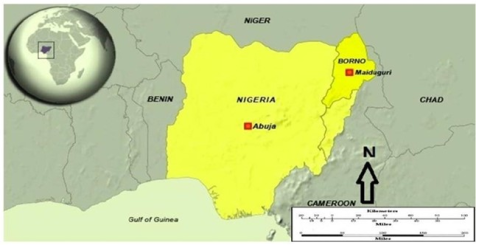
The study area is located in the Sudano-Sahelian belt of North-eastern Nigeria. Generally, Nigeria covers a geographical area of approximately 924,000 km², situated between latitudes 4° and 14° north and longitudes 2° and 14° east. Sharing borders with Niger, Chad, Cameroon, and Benin, the topography of the study area is Sudan savannah with fringes of Sahel savannah in the north eastern part (
Figure 1). The average rainfall in Borno State ranges from approximately 450-500mm/year in the extreme north. The rainfall occurs during well-defined rainy seasons lasting a maximum of four to five months (May to August).
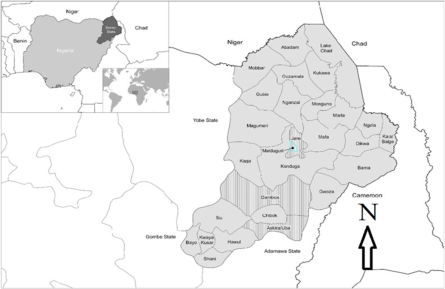
More specifically, Borno State (the study area) is located within latitude of 10º N and 14º N and longitude of 11º 30 E and 14º 45E. The State has a total landmass of about of 61, 435sq km. It shares common borders with the Republic of Niger to the north, the Republic of Chad to the northeast, and the Republic to the east. It also shares borders with Adamawa State to the south, Gombe State to the southwest, and Yobe State to the west. Borno State comprises 27 local Government Areas (LGAs).
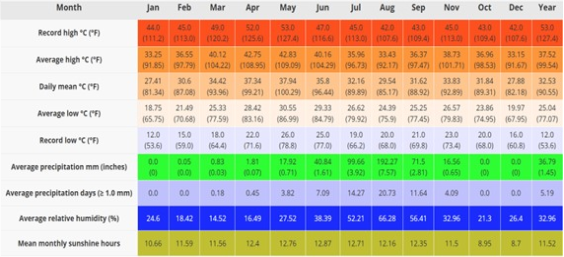
The climate of Borno State is variable, characterised by rainfall fluctuations across a strong latitudinal zone. The rainy season in this northeastern state begins around June or July each year. The state also experiences high relative humidity throughout the year. The hottest period is in April, with an average temperature of 38°C, while January is the coldest month, averaging about 23°C. August is the wettest month, with an average rainfall of 118.6 mm, and December is the windiest, with an average wind speed of 11 km/h.
Based on the Koppen climate classification, Borno State falls within the dry Sahel, surrounded by sandy savannah and isolated hills in the north-eastern and southern parts of the state. This is a hot semi-arid climate (Bsh). It is usually found in the dry Sahel (northern Borno). The southern part of the State has an annual average temperature of 28.3°C (82.9°F). Borno is one of the hottest states in the country; however, the maximum daytime temperatures generally do not exceed 40°C (104°F) most of the year, and the dryness makes the heat bearable. The warmest months are March to April, when daytime temperatures can exceed 40°C
| [2] | Bakari A (2014) Assessing the impact of anthropogenic activities on groundwater quality in Maiduguri, Nigeria. The International Journal of Engineering and Science: 3(4): 35-40. https://doi.org/10.5897/JGMR13.0196 |
[2]
.
The heaviest showers rarely last long and are a far cry from the regular torrential showers common in many tropical regions. Overall, the State's climate is dominated by the harmattan wind, which carries Saharan dust over the land. The dust dims the sunlight, thereby significantly reducing temperatures. The summary of monthly climate variability in the study area is shown in
Figure 2.
2. Geology and Hydrology of the Study Area
The Borno/Chad Basin has been a structural depression since the early Tertiary period, with subsidence and sedimentation dominating over erosion. The Chad Basin was a tectonic crossroads between the NE-to-SW trending Tibesti-Cameroon Trough and the NW-to-SE trending Air Chad Trough. More than 3000 m of sediments were deposited. The basement complex is exposed along the basin's eastern, southeastern, southwestern, and northern rims; its configuration beneath the lake sediments is similar to a horst and graben zone
| [24] | Obaje NG (2009) Geology and mineral resources of Nigeria. Berlin: Springer. |
[24]
. The Chad Basin stratigraphy follows a depositional sequence from top to bottom, beginning with younger Quaternary sediments and progressing to the Plio-Pleistocene Chad Formation, Turonian-Maastrichtian Fika shale, late Cretaceous Gongila Formation, and Albian Bima Formation. The Bima sandstone is the deepest member of the aquifer series, resting unconformably on the basement complex rocks. Its thickness ranges from more than 250 to approximately 2000 metres above sea level, and its depth ranges from 2700 to 4600 metres. According to a groundbreaking study by
| [4] | Barber W, Jones DG (1960) The geology and hydrology of Maiduguri, Bornu Province. Rec. Geol. Surv. Nigeria: 5-20. |
[4]
, the Chad Formation is at least 548 m thick at Maiduguri and could be 600 to 700 m thick in the basin's centre. The Pliocene-Pleistocene Chad Formation and Quaternary sediments are the Maiduguri region's primary groundwater sources
| [12] | Isiorho SA, Matisof G (1990) Groundwater recharge from Lake Chad. Limnology and Oceanography: 35(4): 931-8. |
[12]
.
The Borno Basin, which corresponds to the state's Chad Basin, dominates the hydrology of Borno State. It covers one-tenth of the total area of the Chad Basin, which includes the Chadian and Cameroonian republics. It is part of the Western Central African Rift System (WCAS), which was formed during the Cretaceous period by the mechanical separation of African crustal blocks. The basin is a component of the West Africa Rift Subsystem (WAS) of the West African Craton
| [8] | Goni IB, Taylor RG, Favreau G, Shamsudduha M, Nazoumou Y, Ngounou Ngatcha B (2021) Groundwater recharge from heavy rainfall in the southwestern Lake Chad Basin: evidence from isotopic observations. Hydrological Sciences Journal: 8: 1359-71. https://doi.org/10.1080/02626667.2021.1937630 |
[8]
.
Since the early Tertiary period, the Borno/Chad Basin has been a structural depression characterised by subsidence and sedimentation rather than erosion. Over 3600 metres of sediment were deposited in the Chad Basin, which served as a tectonic crossroads between the NE-to-SW-trending "Tibesti-Cameroon Trough" and the NW-to-SE-trending "Air-Chad Trough"
| [6] | Crosby B (1992) Stakeholder analysis: a vital tool for strategic managers. USAID's Implementing Policy Change Project. |
[6]
. The crystalline basement complex is found along the basin's eastern, southeastern, southwestern, and northern rims, with a horst and graben zone-like configuration beneath the lake sediments. The stratigraphy of the Chad Basin (Borno sub-basin) shows a depositional sequence from top to bottom, beginning with younger Quaternary sediments and progressing to the Pliopleistocene Chad Formation, Turonian-Maastrichtian Fika shale, late Cretaceous Gongila Formation, and Albian Bima Formation
| [5] | Bura B, Goni IB, Sheriff BM, Gazali AK (2018). Occurrence and distribution of fluoride in groundwater of Chad formation aquifers in Borno state, Nigeria. Int J Hydrol.: 2(4): 528-37. https:/doi.org/10.15406/ijh.2018.02.0012 |
| [9] | Goni, I. B. "Tracing stable isotope values from meteoric water to groundwater in the southwestern part of the Chad basin." Hydrogeology Journal 14.5 (2006): 742-752.
https://doi.org/10.1007/s10040-005-0469-y |
| [18] | Miller R E, Johnston R H, Olowu J A I, Uzoma J U, (1968) Groundwater hydrology of the Northern Nigeria in Borno and Dikwa Emirates, with special emphasis on the flow life of the artesian system. USGS Water Supply Paper 1757. |
[5, 9, 18]
.
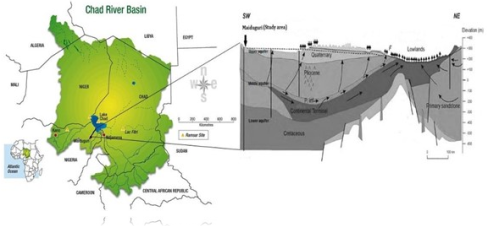
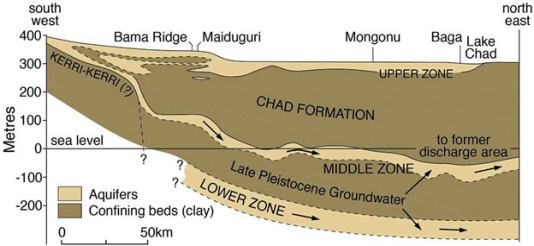
The Chad Formation gradually dips gently east and northeast towards the shores of Lake Chad, conforming to the land surface's slope. Except for a belt of alluvial deposits around the edge of the basin, the formation is of lacustrine origin and consists of thick beds of clay intercalated with irregular beds of sand, silt, and sandy clay. As shown above (
Figure 3),
| [4] | Barber W, Jones DG (1960) The geology and hydrology of Maiduguri, Bornu Province. Rec. Geol. Surv. Nigeria: 5-20. |
| [5] | Bura B, Goni IB, Sheriff BM, Gazali AK (2018). Occurrence and distribution of fluoride in groundwater of Chad formation aquifers in Borno state, Nigeria. Int J Hydrol.: 2(4): 528-37. https:/doi.org/10.15406/ijh.2018.02.0012 |
[4, 5]
divided the Chad Formation into three water-bearing zones designated upper, middle, and lower aquifers (
Figure 4).
3. Methodology
This study employed a stakeholder analysis approach that emphasises empowering grassroots groups, including youth and women's organisations, as well as individuals lacking established social connections
| [17] | McNamara, M (2012) Starting to untangle the web of cooperation, coordination, and collaboration: A framework for public managers. International Journal of Public Administration: 35(6): 389-401.
https://doi.org/10.1080/01900692.2012.655527 |
[17]
. An analytical categorisation technique was applied, as it enables the researcher to group stakeholders according to their knowledge of the system and prevailing conditions. Instruments that assessed power, legitimacy, interest, and impact levels were used in stakeholder categorisation. The analysis began in November 2025 to January 2026. This was aimed at identifying stakeholders who are addressing current, emerging, and future groundwater management challenges in the study area. According to
| [10] | Hare M, Pahl-Wostl C (2002) Stakeholder categorisation in participatory integrated assessment processes. Integrated Assessment: 3(1): 50-62.
https://doi.org/10.1002/casp.774 |
| [19] | Mitchell RK, Agle BR, Wood DJ (2007) Toward a theory of stakeholder identification and salience: Defining the principle of who and what really counts. Academy of Management Review 4: 853-86.
https://doi.org/10.1108/S2514-175920170000006 |
| [20] | Mitchell RK, Van Buren III HJ, Greenwood M, Freeman RE (2015) Stakeholder inclusion and accounting for stakeholders. Journal of Management Studies 52: 851-77.
https://doi.org/10.5840/beq200818214 |
[10, 19, 20]
, the quantity and categories of stakeholders are unbounded and contingent on the specific context.
In total, fourteen stakeholder categories were identified (
Table 2), comprising 150 individuals from diverse entities, including local NGOs, government ministries and agencies, a research institute, and the council of traditional leaders. These groups were considered appropriate given their direct involvement in groundwater management and contamination concerns, as well as their potential to deliver enduring local solutions. Group representatives participated in semi-structured interviews, focus group discussions (FGDs), and stakeholder workshops
| [22] | Morgan DL (1997) Focus groups as qualitative research. Sage. |
[22]
. Educated stakeholders participated in English-language interviews, while residents and water users joined FGDs in the area's primary dialect. Institutional representatives, such as government officials, communicated in English, the official public language, whereas community water users and residents, who typically have limited literacy, used their native language. This is intended to improve all-inclusive and sustainable water resource management in Borno State
| [31] | Villada-Canela M, Quandt A, Muñoz-Pizza DM, Reyna A, García-Searcy V (2025) Community engagement in groundwater management to enhance climate resilience: A comparative study of California and Baja California. Agricultural Water Management 321: 109925.
https://doi.org/10.1016/j.agwat.2025.109925 |
| [32] | Wiek A, Larson KL (2012) Water, people, and sustainability—a systems framework for analyzing and assessing water governance regimes. Water resources management 26(11): 3153-71. https://doi.org/10.1007/s11269-012-0065-6 |
[31, 32]
.
Table 1. List of Primary and Secondary Stakeholders Engaged in the Study.
S/No | Key stakeholders | Secondary stakeholders | Engagement strategy |
1 | Residents | Borno State Government | FGD and Interview |
2 | Public water users | Ministry of Water | FGD and Interview |
3 | Farmers union | Ministry of Health | FGD and Interview |
4 | Local Businesses | Ministry of Education | FGD and Interview |
5 | Farmers Union | Ministry of Agriculture | |
6 | Borno Youth Forum | Traditional Leaders | Interview |
7 | Borno Women Forum | University of Maiduguri | FGD and Interview |
8 | | Local NGOs | Interview |
9 | | Manufacturers Association | Interview |
10 | | Borno State Environmental Agency | Interview |
4. Results and Discussions
The main parties impacted by Borno State's sustainable water management issues offer solutions that call for an immediate, comprehensive approach. According to the stakeholders involved, the following general issues need to be addressed (
Table 2).
Table 2. Strategies for achieving sustainable water management in the study area.
S/No | Key stakeholders | Opinion on Sustainable Water Management |
1 | Borno State Government | The state government officials suggest a review of the water management framework to address the situation. Also, a senior Government official believes that Inter-Ministerial Committees on integrated water-resource management (IWRM) will address the current impediments. |
2 | Ministry of Water | Some of the stakeholders interviewed request the enforcement of stringent water management regulations. |
3 | Ministry of Health | The stakeholders from the Ministry of Health believe that water-borne diseases are prevalent in most areas in the study area. |
4 | Ministry of Education | Review of the existing curricula of primary and secondary schools should emphasise the importance of sustainable water management. |
5 | Ministry of Agriculture | Stakeholders suggest that the use of harmful chemicals and fertilisers should be disbanded amongst farmers. |
6 | Residents | The majority of the residents believe that their inclusion in water management will address the situation. |
7 | Public water users | Almost all the public water users engaged think that they are excluded from water management decision-making. |
8 | Farmers union | The representatives of the farmers felt the Government should subsidise bio-fertilizers and discourage the use of chemical fertilizers. |
9 | Local Businesses | Most Business owners opined that pollution prevention is the best strategy to achieve sustainable water management. |
10 | Borno Youth Forum | Members of the youth organization believe that advocacy and awareness creation are the best strategies. |
11 | Traditional Leaders | The traditional rulers believe that local resource mobilisation, educating the citizenry, and partnership with the traditional Institutions will address the situation. |
12 | Borno Women Forum | Women's inclusion and gender mainstreaming in water management will help the situation. |
13 | University of Maiduguri | Research and innovation in water and waste management will provide the desired outcome. |
14 | Local NGO | The officials of the local NGO believe that working in partnership with water managers in designing solutions for the protection of water resources will be vital. |
Educating the public about the advantages of clean, safe water and a healthy environment is the first step in creating a surface and groundwater protection system. In this respect, poor waste disposal practices in Borno State are degrading water sources that are vital for future development and population growth. Therefore, to lessen the effects of anthropogenic contamination, it is essential to educate the public about water pollution. The Borno State Government, through the Ministry of Education and the State Primary Education Board, plays a crucial role at the school level. Some stakeholders claim that 37% (n=13) of educational stakeholders think this ought to be included in the current curriculum.
Great is a novel approach at the pre- and post-primary levels; the National School Curriculum currently only includes social studies, integrated science, and health education. Incorporating environmental education into the current curriculum at all levels is essential. At the community level, better instruction on these subjects is also required. Community associations, especially women's and youth groups, farmers' unions, and other relevant organisations, should be formed to collaborate with local leaders and authorities. Through community and interpersonal networks, local and international NGOs, as well as government ministries like Education, Environment, Water Resources, and Health, must actively promote environmental advocacy and raise awareness. The public must be sufficiently informed. It is unrealistic to expect people to fully cooperate on complex societal issues that are beyond their basic comprehension. They must be informed about the dangers of improper waste disposal and how it affects water systems, both now and in the future. Second, it is obvious that the current legislative framework does not manage water in a sustainable manner. The authorities must enact legislation that regulates surface and groundwater development and prohibits actions that could jeopardise their quantity and quality. Comprehensive water legislation provides a legal foundation for efficient and sustainable resource management, which has numerous benefits. The legislative framework must: (i) clearly define the roles and responsibilities of all institutions and relevant stakeholders in the water sector; (ii) guarantee the development of water stakeholders and public-private partnerships; (iii) guarantee the advancement of water provision mechanisms based on the social and economic value of water; and (iv) enable pollution control through the creation and enforcement of community rules that encourage actual participation at the community level, the current water supply legislation is outdated and dominated by men
| [28] | Sok S, Meas S, Chea S, Chhinh N (2019) Regional cooperation and benefit sharing for sustainable water resources management in the lower Mekong basin. Lakes & Reservoirs: Research & Management 24(3): 215-27.
https://doi.org/10.1111/lre.12277 |
[28]
.
The new legislation should promote gender equality in private water supply. UN Water recently found that women are generally more sensitive to social and environmental issues. Legislation should specify the conditions for water resource planning, allocation, and conservation, as well as the level of stakeholder interaction among institutions.
All State assemblies in the country, including the Borno State Legislative Assembly, should make sure that laws are passed to control the disposal of waste and the careless application of chemical pesticides and fertilisers on agricultural land near water resources. The authority to enforce and prosecute those who engage in improper waste disposal and chemical applications should be granted to state environmental protection agencies.
In a similar vein, local authorities ought to assist local community leaders, including traditional rulers, in convincing the populace to endorse this plan and assume responsibility for its local enforcement. The state should mandate that all pit latrines in both new and existing development areas be lined (Ministries of Environment and Borno State Urban Development Boards). The majority of pit latrines in Northern residential areas are unlined, contaminating urban groundwater supplies regularly. The proliferation of pit latrines in residential areas is unregulated. As the population grows and surface water resources are depleted, groundwater supplies in cities will become increasingly important. An integrated system for disposing of urban waste (sewage) is required.
Currently, state utilities are not involved in the regulation of on-site household sanitation facilities, and the majority of states in the country do not charge fees for these services. In this regard, relevant state agencies should recognise the importance of working with municipal councils to regulate on-site home- or community-based sanitation facilities. A separate budget should also be established to support a long-term maintenance plan for on-site sanitation facilities. To maintain these systems, authorities must quickly assess the true needs for appropriate sanitation systems in each area and develop plans, policies, and budgets. is crucial. To move forward, Nigeria's 36 state assemblies should pass legislation prohibiting the construction of unlined pit latrines in residential areas. Households should also be required to pay sanitation fees equal to at least 1% of development costs to fund the construction of high-quality latrines that meet established technical standards and are appropriate for the local environment. Must create a strong waste management framework that takes into account the ethics, values, and cultural norms of the populace. Accordingly,
contend that all stakeholders must work together to develop sustainable water governance. Because of this, the Borno State Government must design and carry out initiatives that guarantee local women's and youth groups' involvement. This has several advantages, including protecting the environment and groundwater resources, which will lessen the risk of diseases brought on by unsanitary conditions
| [27] | Salman YG (2007) Water contamination with protozoa in Kirkuk province. Tikrit Journal of Pharmaceutical Sciences: 3(1): 78-85. |
[27]
. As a bonus, it will give unemployed women and young people—who are usually the lowest earners—job opportunities. In this regard, the federal government should select a possible location for the initial pilot programme. To mainstream this policy, the government should form a special task force committee that includes state officials, representatives of the locals and water users, groups of women and youth, community leaders, local religious organisations, local NGOs, and professional associations. All of the federation's states and local councils ought to increase this.
Fourth, the Borno State Government uses the current structure (top-down governance). Because of this,
| [24] | Obaje NG (2009) Geology and mineral resources of Nigeria. Berlin: Springer. |
[24]
promoted a bottom-up strategy that eliminates the bureaucratic bottlenecks associated with the top-down strategy. To handle water and waste management as sub-systems of a larger planning group, each of which influences the other, a more integrated governance framework that unites the pertinent stakeholders (government ministries, water user groups, academia/technical experts, and all other relevant institutions) should be implemented. The Borno State House of Assembly ought to enact laws about water management in this regard. Urban planning, water and waste management, and other municipal services will become more efficient as a result of this. This is due to the implicit relationships between these supposedly distinct entities, which must be managed holistically to prevent groundwater contamination and environmental degradation.
The current piecemeal strategy is ineffective. For instance, in order to safeguard and efficiently manage the water resources of the region in question, all 36 state ministries of water and the environment should collaborate with the various universities in their field, including any available technical experts, to identify and map all potential sources of pollution within cities.
| [1] | Adetokunbo, P., Eluyemi, A. A., Aguda, S., Jegede, E., Omoseyin, T., Sanuade, O. A., & Adesina, R. B. (2025). Decadal Trends and Periodicity of Terrestrial Water Storage in Nigeria-GRACE Satellite Observations. Open Journal of Geology, 15(7), 343-357. https://doi.org/10.4236/ojg.2025.157017 |
| [2] | Bakari A (2014) Assessing the impact of anthropogenic activities on groundwater quality in Maiduguri, Nigeria. The International Journal of Engineering and Science: 3(4): 35-40. https://doi.org/10.5897/JGMR13.0196 |
[1, 2]
in question. To find patterns in the quantity and quality of water, the nation's various water ministries must work with academic institutions to carry out an extensive monitoring programme. All pertinent agencies, stakeholders, and the Ministries of Health must have access to this information. In a similar vein, the Ministry of Environment and the Borno State urban development boards can collaborate closely to create regulations that lessen the negative effects of new construction on the environment. Plans and strategies for long-term pollution prevention and control will be greatly aided by this partnership
| [27] | Salman YG (2007) Water contamination with protozoa in Kirkuk province. Tikrit Journal of Pharmaceutical Sciences: 3(1): 78-85. |
[27]
.
Fifth, the stakeholders at the University believe that stronger connections between different national and regional institutions are necessary to guarantee sustainable management of Nigeria's water resources. This is consistent with
| [25] | Pattern M. (2016) Questionnaire research: A practical guide. Routledge. |
[25]
. For instance, cooperation between the riparian nations of the Lake Chad Basin (Nigeria, Niger, Chad, and Cameroon) varies regionally. They claimed that it is still difficult to assist in the areas of health, education, rural development, social issues, and water and sanitation, even with the presence and efforts of numerous international development partners operating in Nigeria. However, strengthening the current bilateral relations is essential, particularly with the local communities. Particularly in areas like education, capacity building, and advocacy for sustainable water management issues, development partners must strengthen their community-level commitments
| [28] | Sok S, Meas S, Chea S, Chhinh N (2019) Regional cooperation and benefit sharing for sustainable water resources management in the lower Mekong basin. Lakes & Reservoirs: Research & Management 24(3): 215-27.
https://doi.org/10.1111/lre.12277 |
[28]
. Additionally, development partners can work with local non-governmental organisations (NGOs) that need to strengthen national and state institutional frameworks in areas such as institutional capacity building, international and local policy development, and manpower development. Sustainable management of Nigeria's water resources will be ensured by increased institutional capacity at the federal, state, and local levels. According to the institutional stakeholders (n=20; 50%), the Borno State Government has dedicated significant resources to enhancing the state's access to affordable, safe, and clean water. They contended that access to water and sanitation remained unattainable at the end of 2015, despite their pledges in previous Millennium Development Goals. Therefore, governments must fully understand the necessity of giving water resource management top priority in their development policies in order to meet the objectives and targets of the Sustainable Development Goals (SDGs) both now and in the near future. Governments must also make sure that water laws are strictly enforced and that water policies and strategies are implemented effectively. Ensuring sufficient returns from cost recovery to fund data collection, system status monitoring, and resource management is equally crucial for sustainable water resource management. Transboundary cooperation through organisations like the Niger Basin Authority and Lake Fifth, the stakeholders at the University believe that stronger connections between different national and regional institutions are necessary to guarantee sustainable management of Nigeria's water resources
| [29] | Ternes B (2018) Groundwater citizenship and water supply awareness: investigating water‐related infrastructure and well ownership. Rural Sociology 83(2): 347-75.
https://doi.org/10.1111/ruso.12179D |
| [30] | United Nations. (2024) Department of Economic and Social Affairs, Population Division. World population prospects, 2024. https://population.un.org/wpp/un.org |
[29, 30]
.
For instance, cooperation between the riparian nations of the Lake Chad Basin (Nigeria, Niger, Chad, and Cameroon) varies regionally. They claimed that it is still difficult to assist in the areas of health, education, rural development, social issues, and water and sanitation, even with the presence and efforts of numerous international development partners operating in Nigeria
| [28] | Sok S, Meas S, Chea S, Chhinh N (2019) Regional cooperation and benefit sharing for sustainable water resources management in the lower Mekong basin. Lakes & Reservoirs: Research & Management 24(3): 215-27.
https://doi.org/10.1111/lre.12277 |
[28]
. However, strengthening the current bilateral relations is essential, particularly with the local communities. Particularly in areas like education, capacity building, and advocacy for sustainable water management issues, development partners must strengthen their community-level commitments. Additionally, development partners can work with local non-governmental organisations (NGOs) that need to strengthen national and state institutional frameworks in areas such as institutional capacity building, international and local policy development, and manpower development. Sustainable management of Nigeria's water resources will be ensured by increased institutional capacity at the federal, state, and local levels
| [32] | Wiek A, Larson KL (2012) Water, people, and sustainability—a systems framework for analyzing and assessing water governance regimes. Water resources management 26(11): 3153-71. https://doi.org/10.1007/s11269-012-0065-6 |
[32]
. According to the institutional stakeholders (n=20; 50%), the Borno State Government has dedicated significant resources to enhancing the state's access to affordable, safe, and clean water. They contended that access to water and sanitation remained unattainable at the end of 2015, despite their pledges in previous Millennium Development Goals.
Consequently, the Borno State Government must fully understand the necessity of giving water resource management top priority in their development policies in order to meet the objectives and targets of the Sustainable Development Goals (SDGs) both now and in the near future. Governments must also make sure that water laws are strictly enforced and that water policies and strategies are implemented effectively. Ensuring sufficient returns from cost recovery to fund data collection, system status monitoring, and resource management is equally crucial for sustainable water resource management.