0 | | Peer-Reviewed

Geology and Mineralogy of Soka Iron Mineralization, Eastern Ethiopia

Received: 8 June 2026     Accepted: 18 June 2026     Published: 11 August 2026
Views:       Downloads:
Abstract

The high grade and low grade metamorphic rocks with volcano sedimentary varieties and associated intrusions are the main characteristic geological formations of Eastern and south Eastern Ethiopia. The Mozambique and higher grade metamorphic rock that dominated in the four parts of Ethiopia have limited exposure in the eastern Ethiopia. The Soka iron mineralization area was located in the Harerghe, Oromia Region, Eastern Ethiopia. Generally the current study area is situated in the south west of Harer town. The primary objective of this study was to delineate the geology and mineralogy of iron ore occurred in Soka locality. The objective of this research work is achieved using geological mapping with selective representative ore samples assisted by trenches and pits as working methodologies. The genetic type of iron formation and the host rock of the study area was understood from the field work investigation conducted in the area. The Soka locality iron mineralization is characterized as a vein-related iron formation that hosted within the basement rock of the area. Primarily low to medium grade of biotite, amphibolite schist, and quartzite are the main geological formation of Soka and surrounding areas. The average iron oxides like (Fe2O3) contents in Soka were 53.42%, with a wide range of variation from different samples. The Soka iron mineralization mineralogical compositions are studied from the ore microscope analysis and the dominant ore constituents of analyzed iron ore body are hematite, magnetite and altered goethite assembeledge.

Published in Advances in Applied Sciences (Volume 11, Issue 3)
DOI 10.11648/j.aas.20261103.17
Page(s) 113-120
Creative Commons

This is an Open Access article, distributed under the terms of the Creative Commons Attribution 4.0 International License (http://creativecommons.org/licenses/by/4.0/), which permits unrestricted use, distribution and reproduction in any medium or format, provided the original work is properly cited.

Copyright

Copyright © The Author(s), 2026. Published by Science Publishing Group

Keywords

Mineralogy, Vein Type Iron, Geological Formations

1. Introduction
Geology of the southern and south eastern part of Ethiopia is characterized by the high grade and low grade metamorphic rocks with volcano sedimentary varieties were explained accordingly . The iron mineralization of eastern Ethiopia is studied from the ancient time by the work of geological survey of Ethiopia . The Mozambique and some associated Arabian Nubian shields are the geologic provinces of eastern Ethiopia with little exposures of formation. This part of the country contains different mineral recourses the metallic and industrial mineral commodities including iron. The sedimentary and associated volcanic with metamorphic varieties of the region were the most suitable rock unites that can be used to host iron mineralization in the area. Concerning economical point of view iron ore in the hematite deposit form is very easy to extract and currently exploited concentration all over the world. The sedimentary and associated metamorphic rocks of east and west Harerghe are possibly suitable for this iron ore mineralization as a reconnaissance investigation . The Harerge area and its surrounding areas were characterized by diverse geological formations and govern generally hot – occasionally cold climatic environments with timely changed weather condition of the region .
1.1. Location of the Area
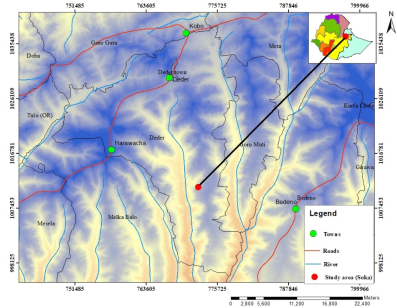
The location and accessibility of study area is found in the Eastern part of Ethiopia. It is accessed through the main asphalt road of Addis Ababa - Adama- Welenchite - Awash - Harer about 530km distance. The target areas are far from Harer town about 122 km at Soka.
Figure 1. Location and accessibility map with main river pattern of the study area.
1.2. Physiography and Drainage Systems
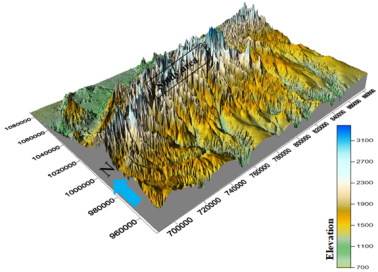
Physiographic condition of eastern part of Ethiopia is mainly characterized by the highest and very low topographic arrangement. The various highest and medium mountainous and very deeper Rmise valleys are typical physiography of the study area and surroundings. The valley and associated with the highland landscape formation with its seasonally variable climatic variability was indicated by . The general physiographic and geomorphologic configuration of the study area and surroundings are shown from Figure 2 below.
Figure 2. Physiography and geomorphologic landscape of the study area.
2. Objectives
The main objective of this research work is to delineate the geologic formation of the area and mineral compositions of Soka iron ore occurrences.
2.1. Methodology
The above objective of the work is achieved through different technical works and approaches.
2.1.1. Geological Mapping
Geologic formations of the study area and surroundings are understand and mapped suitable scale. Geology of the area is covered by simple traversing lines across the strike direction of regional formation. Geological mapping of the area is conducting through sampling of the rock depending on composition, color, degree of weathering and other variability. Geological mapping of the study area is technically assisted by
1). Pitting
2). Trenching
Those explanatory geologic workings are associated with sampling. Pitting and trenching activities are used to know the sub surface geology of the study area and vertical thickness of the rock as well as overburden soil with its variability condition. Number of trenches were excavated in the area is 2 with 15m length and 2m depth each to remove the surficial overburden covers for the iron ore body. Three pits were dugged for cropped out the covered ore body.
2.1.2. Geochemical Analysis
Geochemical study of rocks is very important method of analysis to know the chemical and other physical properties of rocks and other geologic materials. Geochemical analysis of iron ore body and the host rock used to evaluate the quality of iron and to understand its genetic formation as well as the mineralization mechanism. Rock and mineral geochemical study gives clue about the geologic environmental study. The degree of weathering and chemical including the physical alteration is interpreted from the chemistry of rock. Geochemical analysis of rock is essential for examination of anomalous concentration in the earth’s crust materials. Minerals have selective concentration nature during the geological processes and different ore formation. These properties of elements are understood through studying and analyzing the geochemical behaviors of specific elements.
(i). Major Element Analysis
The major elements of rock and iron ore samples are studies. The oxide form of the elemental composition is analyzed from selected samples. Major oxides of the iron ore are important to get information on the processes of iron mineralization. It is very important to know the concentration of iron elements from the total oxide form. Major elements of the rock and ore body gives clue for the mineralization mechanism and different physic chemical alteration as well as oxidation processes. Lighter mineral mobilization and corresponding denser concentration and deposition of the process are understood from the oxide element analysis. Major element study is critical to know the iron mineralization formed by especially laterite mineralization processes.
(ii). Physical Study (Bulk Density)
Bulk density (apparent density) is a material property that measures the weight of materials per unit of volume. The bulk density of the rock is describing the weight of sedimentary rock grain or crystals (igneous and metamorphic rock). Bulk density of a rock is essential for information of ore reserve calculation of mineralization.
(iii). Mineralogical Analysis
(a). Polish Section Study of the Soka Area Iron Ore
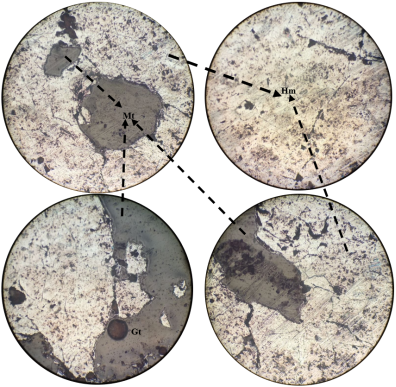
Polished section of iron ore body are prepared from collected field samples to identify and analysis the constituent mineralogy of the ore body. The mineral contents of the ore body were studied under the light reflecting ore microscope. This methodology is used to understand the main constituent mineralogy, type and texture as well as distributions of the ore in relation to the host rock. Analysis of the ore mineralogy using polished section of the ore is important to understand the mineral Para genesis and associated gangue minerals of iron ore. Mineralogical assemebelge (order of formation) is will be identified and described from the ore polished section petrography. The mineralogical assembeledge studied from the polished section ore sample under the reflected light (ore) microscope. The dominant mineralogical constituents are hematite, magnetite and altered minor goethite. The hematite mineral is show replacing the magnetite ore at the grain boundary. The magnetite ore is characterized by the dark gray-brown color, an isotropic and low reflectance with cubic crystal under ore microscope description. The textural descriptions of magnetite mineral from the ore microscopic study is inclusion form within the abundant constituent ore of hematite. The field investigation work for the area the iron mineralization of vein type is clearly confirmed from the ore morphology and textures observed under reflected light (ore) microscope. The polished section ore sample and mineralogical assembeledges are shown below.
Figure 3. Micro photographs of soka iron ore samples (mineral compositions of mt =magnetite intruded to the hematite, hm= hematite and gt= goethite oolitic altered).
(b). Chemical Analysis of Soka Area
The geochemical characteristic of the study area by its major oxides of the host rock and iron ore samples. The laboratory analysis was done for iron ore, carbonate rocks and all surrounding rock of the area. The concentration of iron oxide is high and relatively medium content of aluminum oxide for the hematite and magnetite ore samples. Therefore, the iron oxide (Fe2O3) content in the Soka locality varies significantly, ranging from 0.56% to 87.84%, with an average of 53.42%. Silica (SiO2) content fluctuates between 2.8% and 97.98%, averaging 26.75%, suggesting varying levels of gangue material. Alumina (Al2O3) content ranges from 0.32% to 13.86%, with an average of 4.5%, indicating relatively lower impurity.
Table 1. Major oxide analysis of soka area iron ore body sample and surrounding various rock types.

Field No

SiO2

Al2O3

Fe2O3

CaO

MgO

Na2O

K2O

MnO

P2O5

TiO2

H2O

LOI

SKPX

49.62

13.86

12.96

9.22

6.9

3.6

0.5

0.14

0.2

1.84

0.1

2.04

SKQ

94.92

0.76

1.06

1.36

<0.01

<0.01

<0.01

<0.02

<0.01

0.06

0.42

1.2

SKMR3

3.14

0.32

0.56

30.74

20.14

0.18

<0.01

0.18

0.06

0.06

0.43

44.92

SKT1Q1

97.98

0.94

0.76

0.72

0.3

0.06

<0.01

<0.01

<0.01

0.02

0.33

< 0.01

SKM2

5.2

6.18

81.2

0.8

3.1

<0.01

<0.01

0.04

0.06

0.18

0.89

3.61

SKP3M1

5.98

4.98

79.1

0.88

4

<0.01

<0.01

0.02

0.04

0.06

0.41

3.4

SKT1M2

9.88

4.68

78.84

0.74

3.1

1.52

<0.01

0.04

0.02

0.08

0.48

1.23

SKP2M1

2.8

2.34

87.84

0.68

2.63

<0.01

<0.01

0.04

0.1

0.2

0.56

2.88

SKT1M1

5.3

5.3

82.22

0.7

2.48

<0.01

<0.01

0.06

0.06

0.26

3.46

1.32

SKM3

3.66

6.22

82.22

0.66

3.6

<0.01

<0.01

0.04

0.04

0.16

0.35

2.2

SKH2

29.38

0.94

55.98

0.62

0.16

<0.01

<0.01

0.04

0.14

0.08

2.3

9.07

SKM1

3.8

5.18

81.76

0.66

3.7

0.48

<0.01

0.04

0.04

0.26

0.37

2.65

SKH1

36.04

6.68

50

<0.01

0.84

1.12

<0.01

<0.01

0.04

0.6

0.82

5.1

Average

26.75

4.5

53.42

3.98

4.25

1.16

0.5

0.064

0.073

0.3

0.84

6.64

2.2. Remote sensing study
The study of this research work is use remote sensing study as one part of the method. The study area was investigated and analyzed by Landsat image analysis and perspective interpretation to identify the mafic and felsic rock composition of the area in the office prior to the practical field investigation and observation. The mafic and ultra-mafic lithological formations of the area were clarified in the metamorphic terrain using aerial photos and ENVI- 4.7 software analysis and interoperation.
3. Geology of the Area
The geological formations within the study area and its surroundings are primarily composed of crystalline basement rocks, Mesozoic sedimentary formations, and Quaternary volcanic rocks. The dominant lithology in the study area consists mainly of sedimentary formations and recent volcanic deposits. Iron mineralization occurs in different localities within the study area, with its geological association primarily linked to sedimentary formations and low- to medium-grade metamorphic rocks. The sedimentary formations host laterite iron deposits, while the metamorphic rocks contain vein-related iron mineralization and marble-hosted iron deposits. Marble is one of the surrounding rocks exposed as a vein crossing the surrounding biotitic, quartz and amphibolite schist variety of rock. The presence of biotite, hornblende gneiss and granulite metamorphosed rocks with associated gronodiorite and tonalite intrusions formation of the study is studied by the work of .
3.1. Soka Area
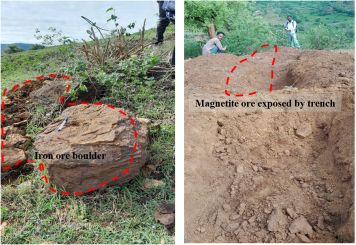
The Soka iron mineralization is situated within the Ramis Valley in eastern Ethiopia primarily localized in the basement rock of the region. The iron resource is concentrated in a limited area and is mineralized within quartz veins that resemble dykes cutting through the country rock. The surrounding rock formations include biotite, mica, and amphibolite schist, with occurrences of floated quartzite. The iron ore mineralization of Soka is occasionally surficial exposed as boulders and iron cobbles and not well exposed throughout the area. It requires excavations of geological explanatory works such as pitting or trenching to crop out the mineralized zones beneath the overburden. Generally the characteristics of Soka iron mineralization vein type and ore is exposed northeast and south west end specific low grade metamorphosed biotite and amphibolite schist dome of the area. Iron mineralized dome is cross cutted by carbonate rock of light grey marble. The biotite and amphibolite rock of the area is highly foliated and dipping to the north east and horizontal - sub horizontally bedded as shown below. The iron ore mineralization of Soka area show magnetite characteristic in the field as the trench sample is tested by magnet.
Figure 4. Varity form of iron ore body (exposed as boulders, gravels of iron fragmentation, vein type magnetite from the trench and surface floated) exposure of soka area.
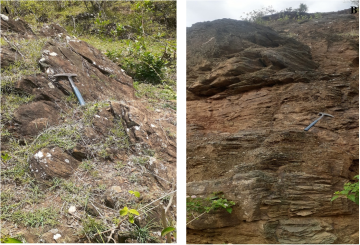
Figure 5. Foliated and tilted surrounding rock of the area (A) and sub horizontal to tilted low grade metamorphosed of (B) biotitic - amphibolite schists rock exposure of soka area and its surrounding rock.
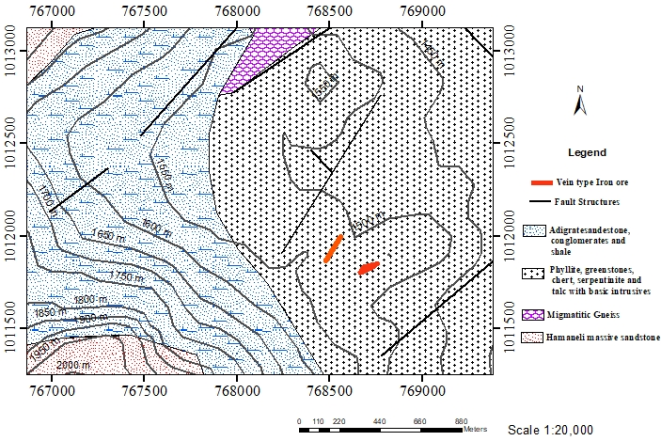
Figure 6. Different lithological formations and vein type iron mineralization and surface occurrence map of soka area.
3.2. Results and Discussion
The research area was investigated by the field observation and final data analysis and interpretation. The field observation for the area gives clue about the iron mineralization mechanisms during the intrusion of the quartz vein and carbonate (marble) across the biotitic amphibolite schist rock. the possible iron ore formation is iron bearing magmatic fluids are injected to the low- medium grade and surrounding carbonate rocks through fractures and joints of the area. The magnetite ore observed from the ore microscopic study is characterized by the secondary cross cutting ore in to the hematite and replacement of the same iron ore. This outcome indicates that the magnetite iron ore mineralization that cropped out by explanatory trenching work is vein filling ore during the magmatic emplacement or mineralization taken place by the hot fluids circulation through the fractures and other open spaces of deformed rock of the area. The goethite ore is another mineral composition of analyzed ore sample of the study area. It is spherical altered which indicates the hematite ore of the area is surficial oxidized and possibly latterized by continues surface geological processes.
4. Conclusion
The iron occurrence exploration work conducted in the Harerghe area, eastern Ethiopia involved geological mapping with pitting and trenching activities four Soka locality. The geology of the iron deposits is mainly characterized by varieties of sedimentary - metamorphosed rock formations. The Soka iron mineralization is primarily hosted within the quartz vein and associated basement rocks, specifically within the metamorphic low to medium-grade of the area. The quartz veins and carbonate rocks were also found in the vein form with discordant (across the country rock) orientation to the surrounding schist. The average iron oxide (Fe2O3) content of the Soka was notably higher about 53.42%, but also displayed significant variability throughout the samples. The ore microscope study for selected iron ore body samples reviles that the main mineralogical assembeledge of the study area is hematite, magnetite, and limited goethite compactions.
Abbreviations

Mt

Magnetite

Hm

Hematite

Gt

Goethite

Acknowledgments
We would like to extend our heartfelt gratitude to the Geological Institute of Ethiopia for this research work. Our appreciation also extends to the Administration of the Oromia Regional State, East Hararghe Zone, Meta and Deder Woredas. Finally, we extend our heart full thanks to the local communities for their support and cooperatives throughout the study.
Author Contributions
Belayneh Digafe Tulu: Conceptualization, Data curation, Formal Analysis, Investigation, Methodology, Software, Visualization, Writing – original draft
Getnet Belachew: Conceptualization, Data curation, Formal Analysis, Methodology, Software, Visualization
Megersa Teku: Data curation, Formal Analysis, Investigation, Methodology, Software, Methodology
Data Availability Statement
The data is available from the corresponding and other authors were generated during the field study.
Conflicts of Interest
The authors declare no conflicts of interest.
References
[1] Berhe, S. M. (1978). Geological map of Dire Dawa (Compilation 1:250,000). Ministry of Mines, Energy and Water Resources, Ethiopian Institute of Geological Survey, Addis Ababa.
[2] Census (2007). Climate – data. Org. (n.d) weather and climate condition of Dire Dwa in January 2025 temperature & climate
[3] Climate - data. Org. (n.d) weather Dire Dwa in January 2025 temperature & cimate. Reterived October 3, 2024 from
[4] Garland, C. R., (1972). Geological map of Adigrat area 1:250,000 (ND-37-7), EIGS, Addis Ababa, Ethiopia.
[5] Gebreyohannes, H. (1989). Facies, depositional environment, diagenesis and hydrocarbon potential of the Jurassic Hamanlei Formation (carbonate-evaporite rocks) in Ogaden Basin Southeast Ethiopia (M. Phil Thesis). University of Reading, U.K.
[6] Getaneh Asefa. (1984). The mineral industry of Ethiopia: Present condition and future prospects. Journal of African Earth Science, 3(3), 331-345.
[7] Greitzer, Y., (1970). Stratigraphy, Hydrogeology and Jurassic Ammonites of the Harar and Diredawa area, Ethiopia. Thesis submitted for the Degree-Doctor of Philosophy, Heberew University, Israel.
[8] Hirko, A., Mergia, G., Nigussie, A., & Dandesa, T. (2021). Seasonal and Annual Meteorological Drought Frequency: Case Study East Hararge Province (Zone).
[9] Jelenc, D. (1966). Mineral occurrences of Ethiopia. Ministry of Mines and Energy, Addis Ababa.
[10] Kazmin, V., (1972). The geology of Ethiopia, Ethiopian Institute of Geological Survey, Addis Ababa, Ethiopia.
[11] Kazmin, V., (1975). Explanatory Note to the geology of Ethiopia, E. I. G. S. bulletin no. 2 Addis Ababa Ethiopia.
[12] Kebede Hailu Belete. (2000). The petrology of the mafic-ultramafic rocks and the surrounding basement, Western Ethiopia and genesis of platinum group minerals related to an Alaskan-type ultramafic intrusion of Yubdo area (Doctoral Thesis). Institute of Mineralogy and Petrology, Karl-Franzens University of Graz.
[13] Mehdl Shumburo, (1968). The Amba Aradom formation, formly upper sandstone, in Behcip. 1985.
[14] Mengesha Tefera, T., Chernet, T., & Haro, W. (1996). Explanation to the geological map of Ethiopia. Ministry of Mines and Energy, Ethiopian Institute of Geological Survey.
[15] Merla, G., E. Abbate, P. Canuti, M. Sagri, and P. Taconi, 1973, Geological map of Ethiopia and Somalia; Consiglio Nazionale delle Richercheltaly, 1:2,000,000.
[16] Mohr, P. A., (1963). Geological Map of the Horn of Africa, 1:2,000,000, Philip and Jacey, London.
[17] Solomon Tadese (2009). Mineral Resources Potential of Ethiopia. Published book Addis Ababa University.
[18] Workineh H, Tadese. Y., Tadese. A., Weke N., Fikadu H.,., Matebe M., Yonas H., Hailemariam K., Kifelemariam G., Temesgen A. and Mulugeta H. (2008-2009). Geological mapping of Eastern Ethiopia. Unpublished report MoM.
[19] Tessema, Y. A.; Aweke, C. S.; Endris, G. S. Understanding the Process of Adaptation to Climate Change by Smallholder Farmers: The case of east Hararghe Zone, Ethiopia. Agric. Food Econ. 2013, 1, 13.
Cite This Article
  • APA Style

    Tulu, B. D., Belachew, G., Teku, M. (2026). Geology and Mineralogy of Soka Iron Mineralization, Eastern Ethiopia. Advances in Applied Sciences, 11(3), 113-120. https://doi.org/10.11648/j.aas.20261103.17

    Copy | Download

    ACS Style

    Tulu, B. D.; Belachew, G.; Teku, M. Geology and Mineralogy of Soka Iron Mineralization, Eastern Ethiopia. Adv. Appl. Sci. 2026, 11(3), 113-120. doi: 10.11648/j.aas.20261103.17

    Copy | Download

    AMA Style

    Tulu BD, Belachew G, Teku M. Geology and Mineralogy of Soka Iron Mineralization, Eastern Ethiopia. Adv Appl Sci. 2026;11(3):113-120. doi: 10.11648/j.aas.20261103.17

    Copy | Download

  • @article{10.11648/j.aas.20261103.17,
      author = {Belayneh Digafe Tulu and Getnet Belachew and Megersa Teku},
      title = {Geology and Mineralogy of Soka Iron Mineralization, Eastern Ethiopia},
      journal = {Advances in Applied Sciences},
      volume = {11},
      number = {3},
      pages = {113-120},
      doi = {10.11648/j.aas.20261103.17},
      url = {https://doi.org/10.11648/j.aas.20261103.17},
      eprint = {https://article.sciencepublishinggroup.com/pdf/10.11648.j.aas.20261103.17},
      abstract = {The high grade and low grade metamorphic rocks with volcano sedimentary varieties and associated intrusions are the main characteristic geological formations of Eastern and south Eastern Ethiopia. The Mozambique and higher grade metamorphic rock that dominated in the four parts of Ethiopia have limited exposure in the eastern Ethiopia. The Soka iron mineralization area was located in the Harerghe, Oromia Region, Eastern Ethiopia. Generally the current study area is situated in the south west of Harer town. The primary objective of this study was to delineate the geology and mineralogy of iron ore occurred in Soka locality. The objective of this research work is achieved using geological mapping with selective representative ore samples assisted by trenches and pits as working methodologies. The genetic type of iron formation and the host rock of the study area was understood from the field work investigation conducted in the area. The Soka locality iron mineralization is characterized as a vein-related iron formation that hosted within the basement rock of the area. Primarily low to medium grade of biotite, amphibolite schist, and quartzite are the main geological formation of Soka and surrounding areas. The average iron oxides like (Fe2O3) contents in Soka were 53.42%, with a wide range of variation from different samples. The Soka iron mineralization mineralogical compositions are studied from the ore microscope analysis and the dominant ore constituents of analyzed iron ore body are hematite, magnetite and altered goethite assembeledge.},
     year = {2026}
    }
    

    Copy | Download

  • TY  - JOUR
    T1  - Geology and Mineralogy of Soka Iron Mineralization, Eastern Ethiopia
    AU  - Belayneh Digafe Tulu
    AU  - Getnet Belachew
    AU  - Megersa Teku
    Y1  - 2026/08/11
    PY  - 2026
    N1  - https://doi.org/10.11648/j.aas.20261103.17
    DO  - 10.11648/j.aas.20261103.17
    T2  - Advances in Applied Sciences
    JF  - Advances in Applied Sciences
    JO  - Advances in Applied Sciences
    SP  - 113
    EP  - 120
    PB  - Science Publishing Group
    SN  - 2575-1514
    UR  - https://doi.org/10.11648/j.aas.20261103.17
    AB  - The high grade and low grade metamorphic rocks with volcano sedimentary varieties and associated intrusions are the main characteristic geological formations of Eastern and south Eastern Ethiopia. The Mozambique and higher grade metamorphic rock that dominated in the four parts of Ethiopia have limited exposure in the eastern Ethiopia. The Soka iron mineralization area was located in the Harerghe, Oromia Region, Eastern Ethiopia. Generally the current study area is situated in the south west of Harer town. The primary objective of this study was to delineate the geology and mineralogy of iron ore occurred in Soka locality. The objective of this research work is achieved using geological mapping with selective representative ore samples assisted by trenches and pits as working methodologies. The genetic type of iron formation and the host rock of the study area was understood from the field work investigation conducted in the area. The Soka locality iron mineralization is characterized as a vein-related iron formation that hosted within the basement rock of the area. Primarily low to medium grade of biotite, amphibolite schist, and quartzite are the main geological formation of Soka and surrounding areas. The average iron oxides like (Fe2O3) contents in Soka were 53.42%, with a wide range of variation from different samples. The Soka iron mineralization mineralogical compositions are studied from the ore microscope analysis and the dominant ore constituents of analyzed iron ore body are hematite, magnetite and altered goethite assembeledge.
    VL  - 11
    IS  - 3
    ER  - 

    Copy | Download

Author Information